Eldergrove Part II: Assembling the Fantasy World
What began as a training project for our artists evolved into a deep exploration of scale, storytelling, and fantasy world-building.
In our last article, we explored how Eldergrove started, from the earliest concept sketches to the development of key assets, vegetation systems and the project’s overall artistic direction.
In this article, we dive deeper into production:
- Assembling the final scene,
- Refining the lighting and composition,
- And navigating the challenges that come with polishing a large-scale fantasy environment.
Similar to before, you’ll hear directly from Annamaria D’Arienzo (Concept Artist) and Fabio Nuzzo (3D Artist Supervisor) as they share behind-the-scene insights from the final phase of Eldergrove.
Special thanks again to the rest of our incredible team at Forge for their passion and talent.
Building up the scene while assets come to life
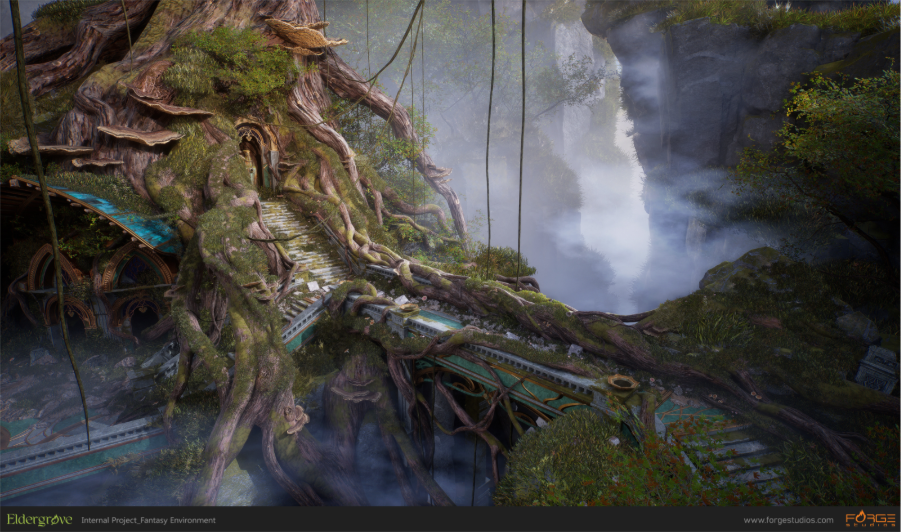
Fabio: Every good environment begins with careful planning, and this project was no different. We started with a small blockout based on initial concepts, defining the central focus and main path, mainly mapping out where we wanted the viewer’s gaze to land.
But we also wanted to convey a sense of scale and vastness, the idea that the world kept going beyond the camera. After the grayboxing phase, we slowly added supporting elements, dedicating less time to distant pieces.
Once we identified the strongest shots and angles, we dressed the scene around them. The rule we followed was always “from large to small.”
One of the best parts was seeing the scene come to life day by day as the team delivered new assets.
Growing through new challenges
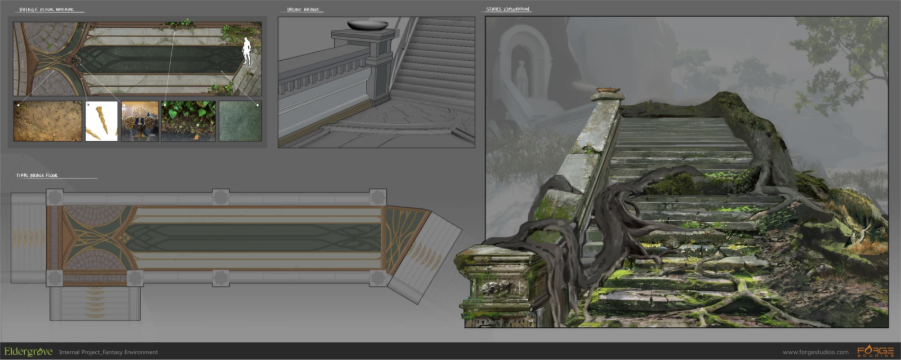
Fabio: Experimenting with Unreal’s texture layering system was a big step forward. Similar to Painter or Photoshop, it lets you layer textures using masks generated from curvature, occlusion and other data.
It’s incredibly powerful but resource-intensive. The real challenge was understanding where it made sense to use it to improve quality without harming performance. Finding that balance definitely expanded my skill set.
Assembling the environment and refining the final composition
Fabio: Once we reached the final phase of production, our workflow had to stay stable and not spend time on reinventing things. The focus was then on polishing, elevating asset quality, refining compositions and applying targeted post-processing.
Since we didn’t have time for deeper optimisation, I prioritised the quality of the static renders we knew we would be producing. Tweaking shots, adjusting lighting, refining post-processing quickly became my favourite.
Managing the light for the first time
Fabio: This was the first time I took on almost the entire lighting process myself, with great support from Daniele during the initial tests.
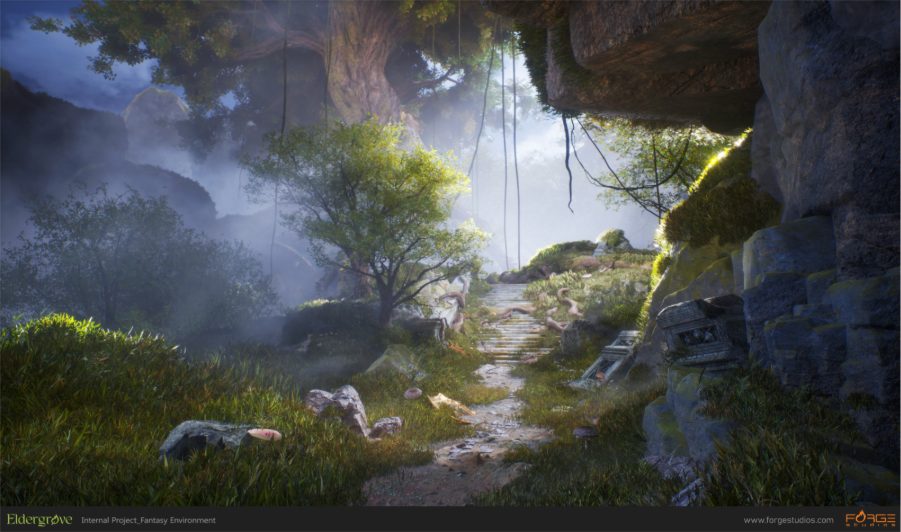
My goal here for was twofold: guiding the viewer’s eyes toward key focal points and creating a mysterious, almost ethereal atmosphere that suited the fantasy setting.
It really took a lot of iteration and experimentation. I would’ve loved more time, but eventually projects need to be wrapped. Regardless, I’m proud of what I achieved and excited to take on lighting again in the future.
Final refinements and optimisation
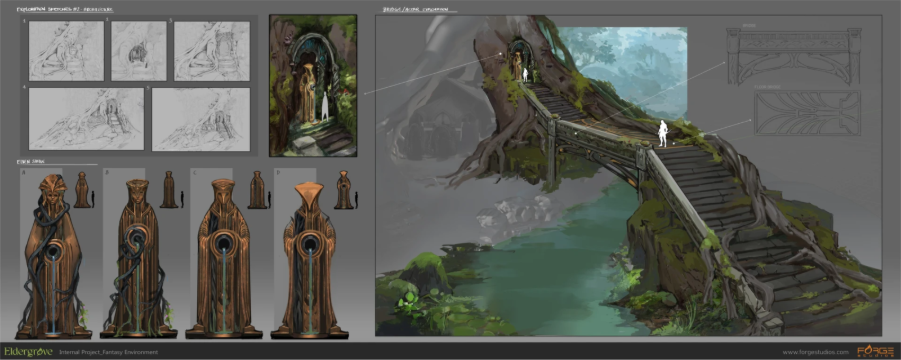
Anna: In the final phase, I focused on making sure the vegetation and set dressing were believable. One of the final tasks was recreating the mood I envisioned: mysterious, ancient and slightly incomprehensible to humans. Nature needed to reclaim the environment, taking over what humans built. That had to be visible in both the lighting and the way we dressed the scene.
I also supported the 3D team with overpainting and additional reference gathering during the last sculpting phase to make sure the result aligned with the concept direction.
Balancing time, quality and the original vision
Anna: Because Eldergrove was so complex, we needed constant communication and compromise. We wanted the world to feel majestic (which was a true showcase of our skills) but the project quickly extended beyond the initial timeline.
Some ideas had to be simplified, and others that involved smaller or distant assets had to be let go. Our priority was always on the natural environment and vegetation, since that was the heart of the project. Even then, we couldn’t include everything we researched or imagined. Nonetheless, we managed to protect the core vision.
Fabio: As we approached the deadline, I focused on refining the final images. This included adjusting the position, rotation and scale of every asset visible in each shot to create the strongest compositions.
Even placing an individual mushroom required a careful thinking process. Everything needed to support the mood and storytelling.
What we are most proud of
Fabio: The entire team! They handled a very complex scene from start to finish and delivered creative, thoughtful solutions at every step.
From Marika’s trim work to Alice’s textures and Flavio’s sculpture statue, everyone brought something unique. Despite many setbacks that came with managing a large and rotating team, we built a fantasy environment with challenges that we overcame together.
Anna: This was the first time I led an end-to-end environment development project. Decision making wasn’t always easy. You have to balance consistency, timing, and a vision that evolves as the project grows. But, our teamwork was exceptional. We started with a few sketches, and through constant support and collaboration, I’m truly proud of the world we created.
Enjoyed learning about Eldergrove? Check out more of this project on Art Station. If you would like to work together, connect with us at business@forgestudios.com.